VAT in Estonia 2026: Complete Guide for Entrepreneurs and E-Residents
If you're an entrepreneur or freelancer managing your own books – especially if you hold Estonian e-residency - understanding how VAT in Estonia works is not optional.
Estonia changed its VAT rates and registration rules in 2025, and those changes apply throughout 2026. Staying compliant isn't just about avoiding penalties - it's about making smart financial decisions.
In this guide we cover the current VAT rates, invoicing rules and compliance steps to help you meet your VAT obligations and avoid costly mistakes.
Facts in this article were checked against the Estonian VAT Act and Estonian Tax and Customs Board guidance on 13 October 2026.
Key takeaways:
-
The standard VAT rate is 24%, in effect since July 1, 2025
-
Reduced rates apply for accommodation services (13%) and for books, listed medicines and press publications (9%)
-
The VAT registration threshold is €40,000 a year, and only turnover with its place of supply in Estonia counts
-
A foreign business without a fixed establishment in Estonia must register from its first taxable supply in Estonia, unless the customer is an Estonian VAT payer who reverse-charges the VAT
-
The EU SME VAT scheme is available for businesses with EU turnover under €100,000
-
From April 2027, the KMD INF annex and the VD report become part of the VAT return itself
-
Invoice VAT calculation: prefer the line-by-line calculation method as opposed to total-based approach to avoid confusion and inaccuracies
Understanding Value Added Tax in Estonia
As a member of the European Union, Estonia follows the EU VAT Directive while maintaining its own specific rates and procedures through the Estonian Value-Added Tax Act.
The Estonian Tax and Customs Board (in Estonian Maksu- ja Tolliamet or MTA) is responsible for VAT administration, including VAT registration, returns, and audits.
Current VAT Rates in Estonia (2026)
The standard VAT rate in Estonia has been 24% since July 1, 2025, with reduced rates of 9% and 13% applying to specific goods and services.
Here's the complete breakdown:
Standard Rate: 24%
-
Applies to most goods and services
-
Up from 22%, which applied from January 1, 2024. This marks an overall increase from 20% to 24% since the end of 2023.
-
The VAT Act sets no end date for the 24% rate
Reduced Rates:
-
13%: Accommodation, with or without breakfast (9% until December 31, 2024)
-
9%: Books and educational literature, medicines and medical devices on the Ministry of Social Affairs list, newspapers and magazines (press publications were taxed at 5% from August 1, 2022 to December 31, 2024)
-
0%: Export of goods, intra-community supply of goods, and services whose place of supply is outside Estonia
Some supplies are exempt from VAT, such as healthcare services, social care, and most financial and insurance services. Exempt is not the same as 0%: you generally cannot deduct input VAT on costs related to exempt supplies.
Table: Estonia VAT Rates and Exemptions (2026)
| Type of Supply | VAT Rate | Notes/Exemptions |
|---|---|---|
| Standard supply of goods/services | 24% | Standard VAT rate for most taxable supply |
| Accommodation services | 13% | Hotels, hostels, guesthouses |
| Books and educational literature | 9% | Printed and electronic |
| Medicines and medical devices | 9% | Only products on the official list |
| Press publications | 9% | Newspapers, magazines, printed and electronic |
| Insurance services | Exempt | No VAT added; input VAT not deductible |
| Financial services | Exempt | Most are VAT-exempt |
| Real estate transactions | Exempt | With exceptions for new buildings/land |
| Investment gold | Exempt | Special rules apply |
| Intra-community supply of goods | 0% | Requires proper documentation and the buyer's VAT number |
| Export of goods | 0% | Goods leaving the EU |
Key VAT Changes in 2025
-
Standard VAT Rate: Increased to 24% (from 22%) as of July 1, 2025. The applicable VAT rate for most goods and services.
-
Accommodation Services: Now taxed at 13%.
-
Press Publications: Taxed at 9%.
-
VAT Exemptions: Insurance services, financial services, most real estate transactions, and investment gold remain exempt from VAT.
2025 Rate Changes Timeline
| January 1, 2025 | July 1, 2025 |
|---|---|
| Accommodation services: 9% → 13% | Standard rate: 22% → 24% |
| Press publications: 5% → 9% |
What Changes in 2027?
Under the VAT Act as it stands, the rates do not change in 2027. The reporting does.
From April 2027, invoice data (until now the KMD INF annex) and intra-community supply data (until now the separate VD report) are reported directly on the VAT return. The separate VD report is abolished. Instead of filling in the return form, you send the Tax and Customs Board the transaction data, directly from your accounting software if it supports this. The deadline stays the same: the 20th of the month after the taxable period.
VAT Calculation on Invoices
While the math might seem straightforward, choosing the wrong calculation method can create small discrepancies that accumulate into meaningful differences—especially with larger amounts and multiple line items.
Using specialized invoicing software like Sliptree automatically handles these calculations and ensures accuracy, helping you avoid costly mistakes while saving valuable time on manual calculations.
Simple VAT Calculation Methods
Adding VAT to net price:
-
Multiply by 1.24 for the total including VAT
-
Example: €500 × 1.24 = €620 (including €120 VAT)
-
Or calculate VAT separately: €500 × 0.24 = €120 VAT
Removing VAT from gross price:
-
Divide by 1.24 to get the net amount
-
Example: €620 ÷ 1.24 = €500 (with €120 VAT removed)
-
VAT amount: €620 - €500 = €120
For 13% or 9% rate calculations:
-
Adding VAT: multiply by 1.13 or 1.09
-
Removing VAT: divide by 1.13 or 1.09
These calculations are essential for proper invoicing and ensuring compliance with Estonian tax regulations.
Line-by-Line vs Total-Based Calculation Methods
One of the most technical aspects of VAT compliance involves proper invoice calculation and rounding.
The Estonian VAT Act does not say whether VAT must be calculated per line or on the invoice total. It requires the invoice to show the taxable amount per VAT rate and the VAT amount in euros. We recommend the line-by-line method, as it provides greater accuracy.
Line-by-Line Method (Recommended):
-
Calculate VAT for each invoice line
-
Round each line's VAT to two decimal places (e.g. 10.01 €)
-
Sum all rounded amounts
Total-Based Calculation Method:
-
Sum up all taxable value
-
Calculate VAT on total
-
Round final result
Example of Both Calculation Methods
Let's say you're invoicing for three services.
Line-by-Line Method
| Product | Net Price | VAT Rate | Calculated VAT | Rounded VAT | SUM |
|---|---|---|---|---|---|
| Service A | 10.15 € | 24% | 2.436 € | 2.44 € | 12.59 € |
| Service B | 15.47 € | 24% | 3.712 € | 3.71 € | 19.18 € |
| Service C | 8.23 € | 24% | 1.975 € | 1.98 € | 10.21 € |
| TOTAL | 8.13 € | 41.98 € |
-
VAT Total: 2.44 + 3.71 + 1.98 = 8.13 €
-
Total amount: 41.98 €
Total-Based Method:
| Product | Net Price | |
|---|---|---|
| Service A | 10.15 € | |
| Service B | 15.47 € | |
| Service C | 8.23 € | |
| SUM | 33.85 € | |
| VAT | 24% | 8.12 € (8.124 €) |
| TOTAL | 41.97 € |
-
VAT Total: 33.85 × 0.24 = 8.124, rounded to 8.12 €
-
Total amount: 41.97 €
Difference: 8.13 - 8.12 = 0.01 €
The differences are not significant, but with larger amounts and more product items, they can be enough to cause confusion.
What Details are Required on Invoices in Estonia?
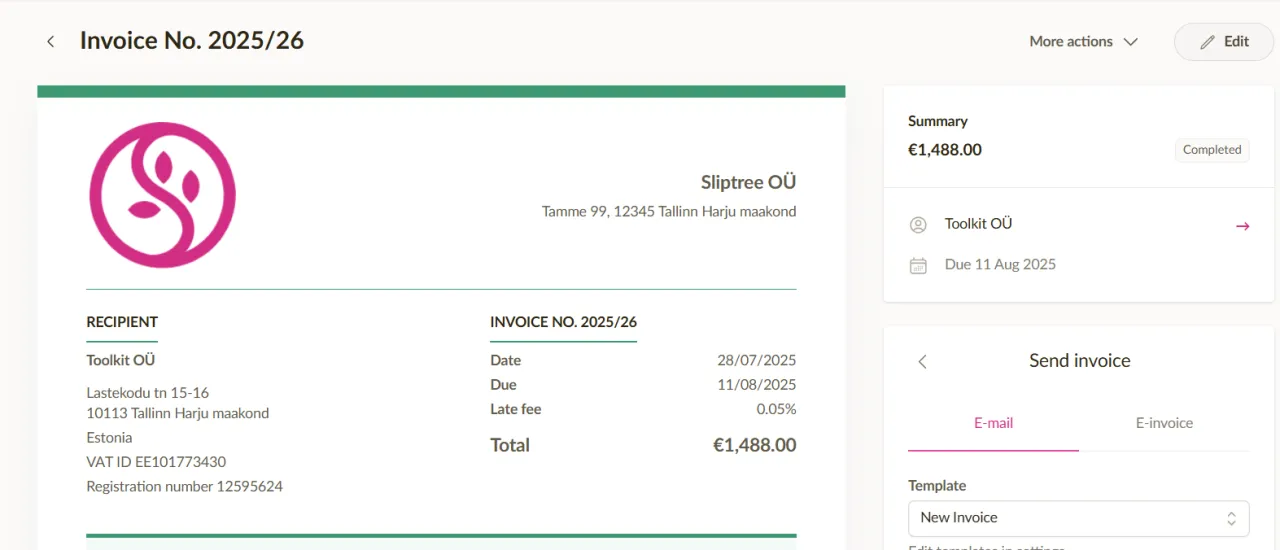
Creating legally compliant invoices protects your business and ensures smooth operations. The Estonian VAT Act sets clear requirements that every VAT-registered business must follow.
Mandatory Invoice Elements for VAT-Registered Businesses
According to the Estonian VAT Act (§ 37), an invoice must include:
-
Invoice number and date - a sequential number and the date of issue
-
Seller details - your company name, address and VAT number (KMKR)
-
Buyer details - client's name and address
-
Buyer's VAT number - if the buyer is liable for the VAT (for example, under reverse charge)
-
Product/service description - clear naming of what was sold
-
Quantity - quantity of goods or extent of services
-
Date of supply - if it differs from the invoice date
-
Unit price without VAT - and any discount not already included in the price
-
Taxable amount per VAT rate - with the rates applied, or the amount of exempt supply
-
VAT amount - in euros
-
VAT exemption or reverse charge basis - if 0%, an exemption or reverse charge applies
The invoice must be issued within 7 calendar days of supplying the goods or services. If you are not VAT-registered, you leave out the VAT number and VAT lines.
Recommended Optional Invoice Elements
While not legally required, these elements help to make your invoices more professional and create trust.
-
Payment due date - when payment must be received
-
Company logo and brand colours - creates professional image
-
Contact information - phone and email for client communication
-
Bank account details - where payment should be made
-
Reference number - helps match payments with invoices
-
Payment terms - conditions and late payment policies
-
Additional comments - relevant information for the client
These additions aren't mandatory but significantly improve client experience and reduce payment delays. Professional invoicing reflects your business standards and helps build trust with customers.
Who Must Register for VAT in Estonia?
A taxable person is any individual or entity making taxable supply in Estonia. VAT registration is required or possible if:
-
Annual turnover exceeds €40,000 (counting only turnover with its place of supply in Estonia)
-
Foreign Companies: A foreign business without a fixed establishment in Estonia must register from its first taxable supply in Estonia, unless the customer is an Estonian VAT payer who reverse-charges the VAT.
-
You wish to deduct input VAT on business purchases
-
Voluntary registration is also possible before reaching the threshold
Once the threshold is exceeded, you have three working days to apply for registration.
Upon registration, you’ll receive a VAT number (KMKR nr), which is essential for invoicing, VAT returns, and intra-community supply.
Small businesses with turnover in other EU countries can benefit from the EU SME VAT scheme, available since 2025.
2025 Changes: Focus on Domestic Revenue
Since January 1, 2025, only turnover whose place of supply is in Estonia counts toward the €40,000 limit. This means:
-
Services whose place of supply is another country, such as most B2B services to businesses in other EU countries, don't count
-
Taxable supply in Estonia counts, including 0% supply
-
Real estate, insurance and financial services also count, unless they are occasional transactions
-
Sale of fixed assets doesn't count
For many digital service providers selling abroad, this reduces the likelihood of mandatory registration.
Small Business Special Scheme for Intra-EU Revenue
The European Union introduced a new SME VAT scheme from 2025. It allows Estonian companies to make supplies in other EU countries without registering for VAT there. Total EU turnover must stay under €100,000 in both the current and the previous year, and turnover in each country must stay under that country's own exemption threshold.
This scheme is particularly valuable for:
-
Digital service providers
-
E-commerce businesses
-
Consulting firms serving EU clients
Common Compliance Mistakes to Avoid
1. Missing Registration Deadlines
If you don't apply within three working days of exceeding the threshold, the Estonian Tax and Customs Board registers you retroactively from the day the threshold was exceeded. You then owe VAT on your sales from that day.
2. Incorrect Rate Application
With multiple rate changes in 2025, applying the wrong VAT rate is a risk. Always verify rates for specific goods and services on the EMTA website.
3. International Transaction Errors
Intra-community supply transactions require careful handling:
-
B2B sales to VAT-registered EU customers: 0% with reverse charge
-
B2C distance sales of goods and e-services to consumers in other EU countries: once these exceed €10,000 a year, the VAT of the customer's country applies. You declare it by registering there or through the EU One-Stop Shop (OSS) scheme
-
Transport services and ancillary services may have special rules, particularly when involving cross-border transactions or international transport.
4. Record-Keeping Deficiencies
The tax authority requires comprehensive documentation. Maintain records of:
-
All taxable supply transactions
-
All receipts and invoices
-
Cross-border transaction evidence
VAT Liability: Filing, Payment, and Refunds
VAT returns must be submitted monthly, by the 20th of the month following the taxation period.
Filing Requirements Might Include:
-
Input VAT: VAT paid on business purchases; deductible if purchases relate to taxable supply.
-
Output VAT: VAT you add to the sales price of goods or services supplied.
-
KMD Form: Standard VAT return - this must be submitted even in case there were no taxable transactions during the period.
-
KMD INF Form: Invoices of €1,000 or more (excluding VAT) per business partner in the period. From April 2027 this data goes on the VAT return itself.
-
VD Form: Intra-community supply reporting, until the new VAT return starts in April 2027. From then on this data also goes on the VAT return.
Payment Deadlines and VAT Refunds:
All VAT obligations must be paid by the 20th of the following month of the taxing period. Note that the payment deadline is the same as the filing deadline!
If input VAT exceeds output VAT in a taxable period, you may claim a VAT refund from the Estonian tax authorities.
Any VAT paid in advance can be credited to future periods.
Practical Compliance Tips
1. Use Professional Software
Avoid creating your invoices manually or using Excel, Word, etc. Use professional accounting or invoicing software to ensure:
-
Correct VAT rate application & calculations
-
Automatic rounding compliance
-
Integration with Estonian tax authorities & systems
2. Make Sure to Include Your Customers' VAT Number to the Invoices
A proper specialised invoice software takes your customer's info straight from the business registry. When creating invoices with Sliptree, you can automatically get the VAT number of any VAT liable entity registered in Estonia, Latvia or Finland.
3. Monitor Key Dates and Threshold Carefully
Keep an eye on your accounting or sales tracking software carefully, not to miss the €40,000 threshold and if relevant, prepare for VAT registration requirements.
Key dates to track:
-
Monthly VAT filing & payment deadlines (20th of each month)
-
Intrastat reporting requirements (if applicable)
Special VAT Rules and Arrangements for Intra-Community & Cross-Border Transactions
-
Intra-Community Supply: Supplies of goods to VAT-registered businesses in other EU countries are zero-rated, but proper documentation and the buyer's VAT number are required.
-
EU Distance Sales: If selling goods online to EU consumers and exceeding €10,000, you must pay VAT of the consumer’s country, either by registering there or through OSS.
-
Foreign Companies: A foreign business without a fixed establishment in Estonia must register from its first taxable supply in Estonia, unless the customer is an Estonian VAT payer who reverse-charges the VAT.
To Sum Up
Staying compliant with VAT in Estonia requires attention to detail and regular monitoring of regulatory changes. With the VAT increase to 24% and evolving international rules, professional guidance or reliable invoicing software becomes increasingly valuable for maintaining smooth operations.
The key is preparation: understand your obligations before you need them, maintain proper records, and don't hesitate to seek clarification from the Estonian Tax and Customs Board when facing complex situations.
Read more: If you want to know about the Estonian e-invoice system and latest changes, continue here!
Also, check out the official guide to VAT for e-residents here.
Frequently Asked Questions
What is the current standard VAT rate in Estonia?
The standard value added tax rate in Estonia is 24%, in effect since July 1, 2025. The VAT Act sets no end date for it. Reduced rates of 9% and 13% apply to specific goods and services.
Will VAT in Estonia change in 2027?
Under the VAT Act as it stands, the rates do not change in 2027. From April 2027, the KMD INF and VD data are reported on the VAT return itself.
When must I register as a taxable person in Estonia?
For Estonian entities, the threshold for VAT registration is €40,000 in annual Estonia-sourced turnover, and you have three working days to apply once you exceed it. A foreign business without a fixed establishment in Estonia must register from its first taxable supply in Estonia, unless the customer is an Estonian VAT payer who reverse-charges the VAT.
Can I register voluntarily for VAT?
Yes, you can register before reaching the threshold. This is often beneficial when you have significant input VAT costs or serve VAT-registered B2B customers.
What records must I maintain?
Keep detailed records of all transactions, including invoices, receipts, customs documentation for imports, and evidence of customer VAT registration status for intra-community transactions.
How do I deduct input VAT in Estonia?
If you are a registered taxable person, you can deduct input VAT on purchases related to taxable supply in your VAT return.
Are foreign companies required to register for VAT in Estonia?
A foreign business without a fixed establishment in Estonia must register from its first taxable supply in Estonia and obtain an Estonian VAT number (KMKR). There is no need to register when all its Estonian customers are VAT payers who reverse-charge the VAT.
What services are exempt from tax in Estonia?
Insurance services, most financial services, certain real estate transactions, and investment gold are commonly exempt from VAT.