What is Peppol? A practical guide for freelancers and small businesses
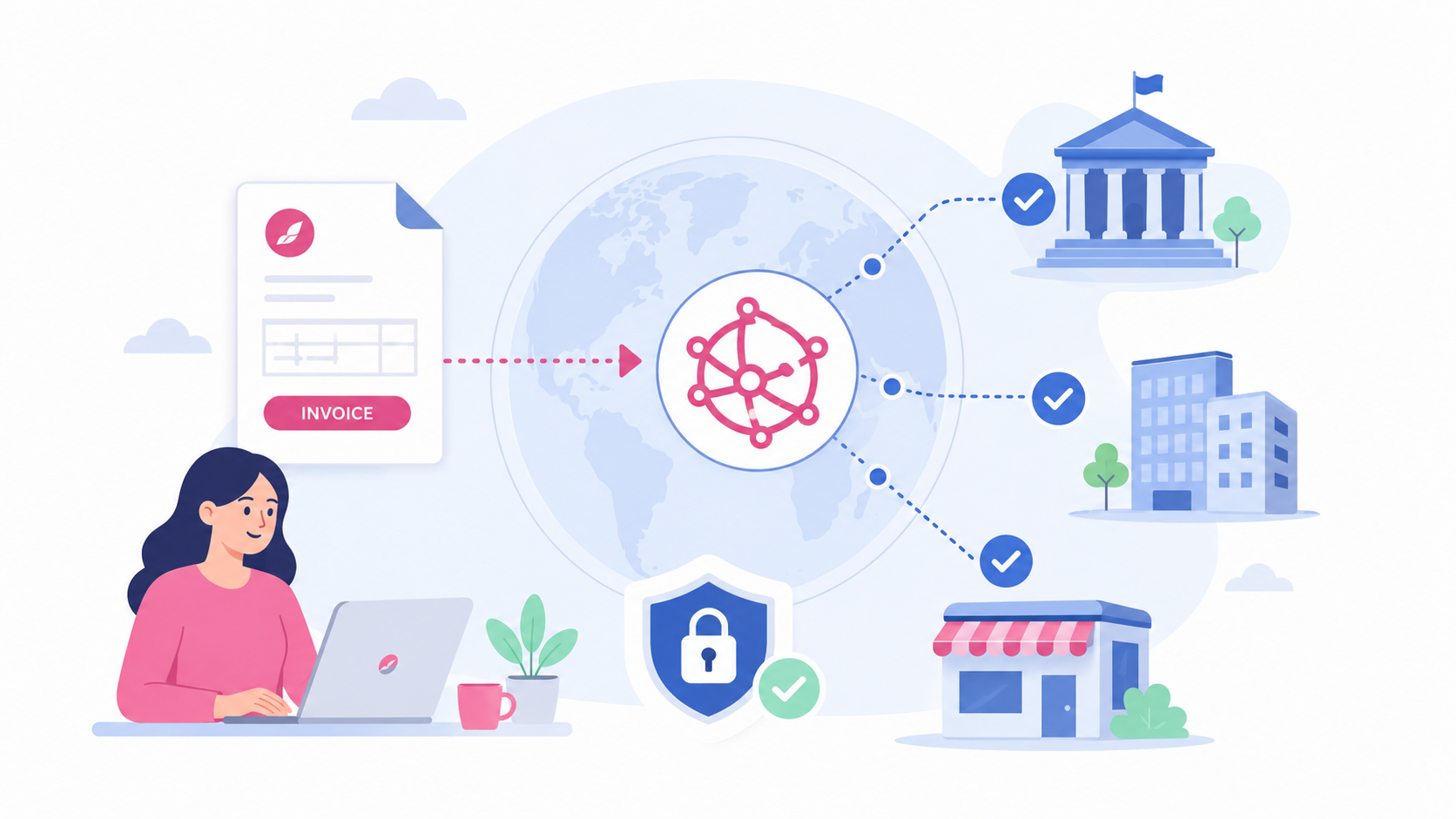
If you invoice clients abroad, work with public sector organisations, or want to spend less time chasing invoice details, you may have come across Peppol.
So, what is Peppol?
Peppol is an international network and set of standards for exchanging electronic business documents, especially electronic invoices. It allows businesses, public sector entities, accounting software, and service providers to send structured documents to each other securely, even when they use different systems.
For freelancers and SMEs, the practical benefit is straightforward: Peppol makes it easier to send invoices that your customer’s accounting system can receive and process automatically. No copying data from PDFs. No retyping invoice lines. Fewer avoidable errors.
Peppol began in Europe, but it is now used well beyond the European Union, including in Singapore, Australia, New Zealand, and many other Peppol-enabled markets.
Quick overview (TL;DR)
Peppol is a secure network for exchanging electronic documents such as invoices, orders, credit notes, and other procurement documents.
In short:
-
Peppol stands for Pan-European Public Procurement Online, and supports secure cross-border electronic document exchange for both business-to-government and business-to-business transactions.
-
It is governed by OpenPeppol together with accredited national Peppol Authorities.
-
Businesses access the Peppol network through a certified Peppol Access Point or software connected to one.
-
Peppol invoices are structured electronic documents, commonly based on Peppol BIS Billing 3.0 and UBL 2.1 XML.
-
It helps reduce manual data entry, improve invoice delivery speed, lower error risk, and support e-invoicing compliance.
What is Peppol?
Peppol is both a secure network and a common rulebook for electronic document exchange.
The Peppol network is the infrastructure that allows businesses, public authorities, and service providers to exchange electronic documents.
The rulebook is made up of Peppol specifications, including the Peppol Business Interoperability Specifications, often called Peppol BIS.
These specifications define how electronic business documents should be structured, sent, received, and validated.
This means a company in Estonia can send a Peppol invoice to a public authority in Finland, or a supplier in Lithuania can send an e-invoice to a customer in another Peppol-enabled country, without both sides needing to agree on a custom technical format.
The origin story of Peppol
Peppol originated in 2008 as a European project to improve public procurement. The name comes from Pan-European Public Procurement Online.
It is governed by OpenPeppol together with accredited national Peppol Authorities, which oversee implementation and compliance within their respective jurisdictions.
Today, it has grown well beyond its original European scope and is now used across Europe, Asia-Pacific, and several other regions, with new jurisdictions continuing to join the network.
Singapore was the first non-European country to adopt Peppol. Australia and New Zealand have also embraced Peppol e-invoicing, which is one reason Peppol is becoming more relevant for small businesses that sell internationally.
What problem does Peppol solve?
Without Peppol, electronic document exchange can quickly become fragmented.
One customer may ask for invoices by email as PDFs.
Another may require a national e-invoicing format.
A public sector buyer may request a structured XML invoice.
A larger private company may use a procurement platform that your accounting system does not connect to directly.
That creates extra admin. You may need to enter the same invoice data into several systems, check different country requirements, and manually confirm whether the invoice was received.
Peppol solves this by creating a common way to exchange documents.
You do not need to build your own connection to every customer’s accounting system. You use a Peppol service provider, access point provider, or Peppol-enabled accounting software, and the network handles the standardised exchange.
How does the Peppol network work?
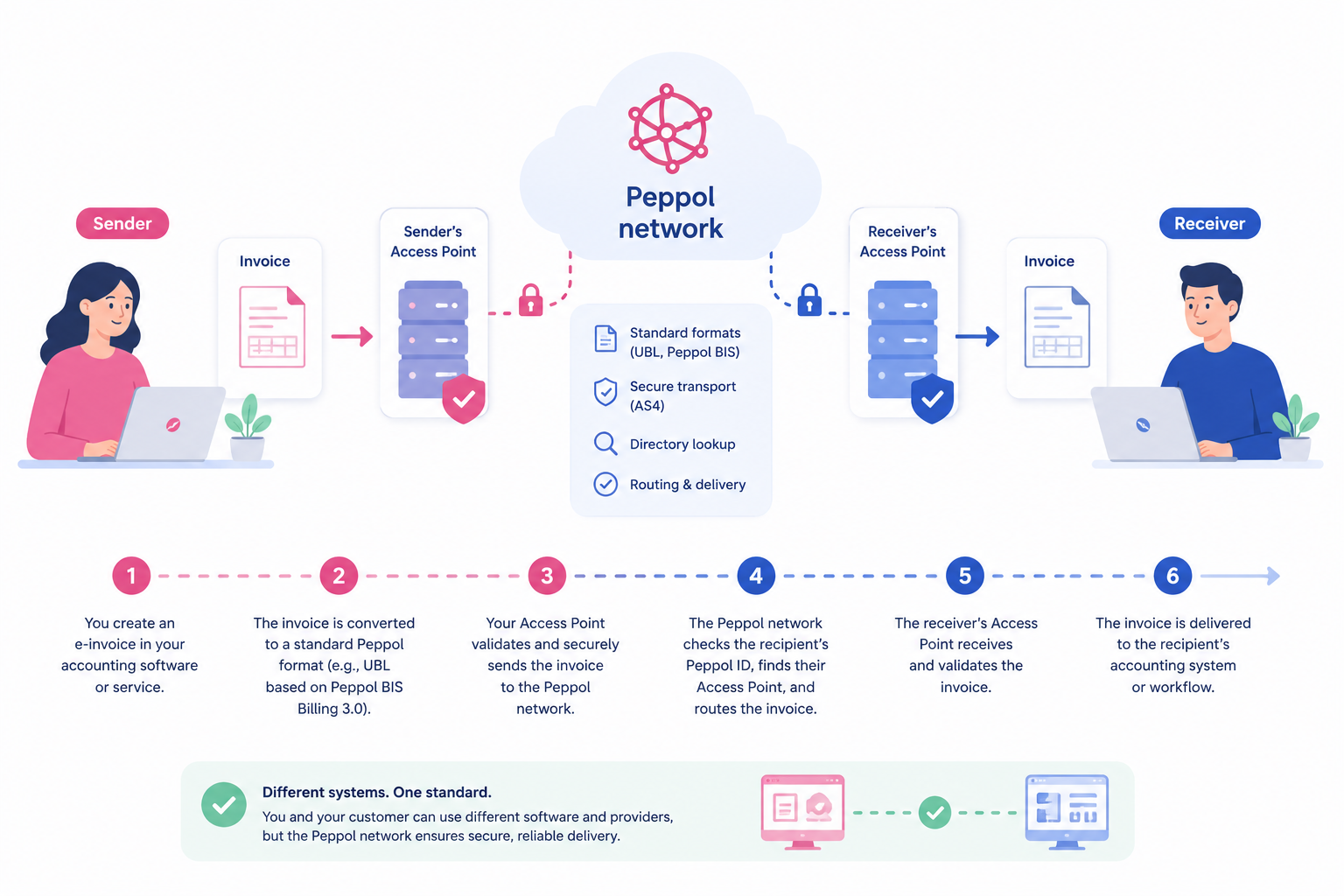
The Peppol network uses shared standards so different systems can understand each other. These standards cover document formats, message transport, security, and recipient discovery.
A simple way to think about it is email, but for structured business documents. You do not need to use the same email provider as your customer to send them a message.
In a similar way, you do not need to use the same accounting software or Peppol service provider as your customer to send them a Peppol invoice.
A typical Peppol document exchange uses:
-
a structured document format, such as UBL 2.1 XML;
-
Peppol BIS, such as Peppol BIS Billing 3.0 for invoices;
-
the AS4 transport profile for secure document transmission;
-
a Peppol Participant ID to identify the receiver;
-
Service Metadata Publisher records to find where documents should be delivered.
This can sound technical, but most businesses do not need to manage these parts directly. Your accounting software, invoicing tool, Peppol service provider, or certified access point provider usually handles them in the background.
What is the four-corner model?
Peppol uses a four-corner model for document exchange. This is one of the main reasons it works across different systems, countries, and service providers.
The four corners are:
-
The sender
-
The sender’s Peppol Access Point or service provider
-
The receiver’s Peppol Access Point or service provider
-
The receiver
For example, imagine you are a small business sending an invoice to a customer in another country. You create the invoice in your invoicing or accounting system.
Your system sends it through your Peppol Access Point. That access point validates the document and routes it securely through the Peppol network to the customer’s access point.
The customer then receives the structured invoice directly in their accounting or procurement system.
This model eliminates the need for direct one-to-one agreements between every sender and receiver. You do not need a separate technical setup for each customer. As long as both sides are Peppol participants connected through certified access points, documents can be exchanged.
What is a Peppol Access Point?
A Peppol Access Point is your connection to the Peppol network.
To send or receive Peppol documents, businesses must either register with a certified access point or use software connected to one.
The access point securely routes the document through the Peppol network and performs the technical validations required by the Peppol specifications, while additional business validations may be performed by the sender's or receiver's systems.
Access points are operated by certified service providers. Depending on your setup, your accounting software, invoicing tool, ERP system, or e-invoicing operator may already work with a certified Peppol Access Point provider.
For example, Sliptree connects to the Peppol network through its certified Access Point partner, Billberry, so users can send compliant Peppol e-invoices without managing the technical infrastructure themselves.
What is a Peppol ID?
A Peppol ID, also called a Peppol Participant ID, is the identifier used to find a business or public sector entity on the Peppol network.
It works like a delivery address for electronic business documents. Instead of sending an invoice to an email address, the sender uses the receiver’s Peppol ID. This helps the network route the document to the right place.
Peppol IDs are often based on existing business identifiers, such as VAT numbers, company registration numbers, or other national identifiers. The exact structure depends on the country and identifier scheme.
Behind the scenes, Peppol uses discovery services to find out where documents should go. A Service Metadata Publisher, or SMP, stores business delivery addresses and information about which document types a participant can receive. The Service Metadata Locator, or SML, helps locate the correct SMP.
As a small business, you normally do not need to deal with these technical or regulatory layers directly. Most Peppol service providers handle this during setup.
What documents can be exchanged through Peppol?
Peppol is best known for e-invoicing, but it is not limited to invoices.
The network supports the exchange of different electronic business documents used in procurement processes. These can include electronic invoices, credit notes, purchase orders, order responses, despatch advice, catalogues, and other procurement documents.
For many small businesses, Peppol e-invoicing is the most relevant use case. A Peppol invoice is not simply a PDF sent by email. It is a structured electronic invoice that can be read by software.
In Peppol, invoices are commonly sent as structured UBL 2.1 XML documents using Peppol BIS Billing 3.0. This structured format allows invoice data such as supplier details, customer details, invoice lines, VAT information, due dates, and totals to be imported into the receiver’s accounting system automatically.
That is very different from a PDF invoice. A PDF may look professional, but it usually still needs to be manually entered or processed with OCR. A true e-invoice carries the data in a structured format, so the receiver’s system can process it with much less manual work.
Peppol and e-invoicing rules in Europe
Peppol plays an important role in European e-invoicing because it supports common standards and helps businesses meet public procurement requirements.
European Directive 2014/55/EU requires public sector bodies in the EU to be able to receive and process electronic invoices that comply with the European standard for e-invoicing.
Peppol is one of the most widely used networks for meeting these requirements, although national implementations and accepted platforms vary by country.
In practice, many European countries use or accept Peppol for public sector e-invoicing. EU public sector entities are required to be able to receive compliant electronic invoices, although exact national rules, platforms, and accepted networks vary by country.
In many cases, a PDF invoice is not enough. You may need to send a structured e-invoice through Peppol or another approved national system.
Peppol also supports business-to-business transactions. Even when Peppol is not legally required, private companies may prefer it because it reduces manual processing and makes invoice handling faster.
Why Peppol matters for freelancers and SMEs
Peppol may sound like something built for governments and large enterprises, but it is increasingly useful for smaller businesses too.
If you send only a few invoices per month, manual invoice handling may not feel like a major issue. But the more customers, countries, and requirements you deal with, the more time you lose on admin. Peppol makes document exchange more predictable and easier to track.
The practical benefits include:
-
less manual data entry,
-
fewer data-entry mistakes,
-
faster invoice delivery,
-
better invoice tracking,
-
easier cross-border e-invoicing,
-
simpler compliance with customer or public sector requirements.
Invoices and related documents can move almost instantly between trading partners. This can improve cash flow, especially when your customer uses automated invoice matching and approval processes.
Peppol can also reduce fraud risk compared with informal invoice exchange by email. Because documents move through certified access points and secure network processes, there is less room for fake payment details or altered invoice attachments to slip through unnoticed.
There are cost benefits too. Research and industry estimates often show that automated e-invoicing is much cheaper than manual invoice processing.
Actual savings depend on transaction volumes, software, and internal processes.
Peppol, accounting software, and integration
Most businesses do not “use Peppol” directly. They access Peppol through accounting software, invoicing software, an e-invoicing operator, or another Peppol service provider.
If your accounting system has Peppol integration, you may be able to send and receive Peppol invoices without leaving your usual invoicing workflow. If it does not, you may need an external Peppol service provider or access point provider.
When choosing software, check whether it supports Peppol BIS Billing 3.0, UBL format, sending to Peppol-enabled countries, recipient lookup or Peppol ID handling, and clear status information for sent invoices.
Sliptree supports sending e-invoices via Peppol using Peppol BIS 3.0 in UBL format. This enables cross-border invoicing between countries connected to the Peppol network, including Estonia, Latvia, Lithuania, Finland, and other Peppol-enabled countries. Sliptree also indicates which network was used for each invoice, such as the Estonian network or Peppol.
For a freelancer or small business, that kind of support makes Peppol feel less technical. You create the invoice, choose the right recipient, and the system handles the technicalities and the network side.
Peppol vs PDF invoices by email
A common misunderstanding is that a PDF invoice sent by email is the same as an e-invoice. It is not.
A PDF invoice is a visual document. A person can open it, read it, and manually enter the information into accounting software. Some systems can extract data from PDFs, but that still depends on scanning, OCR, or other interpretation.
A Peppol e-invoice is a structured electronic document. The invoice data is already in a machine-readable format, such as UBL XML. The receiving accounting system can import and process the data automatically.
| Feature | Email or PDF invoice | Peppol invoice |
|---|---|---|
| Format | Human-readable document | Structured electronic data |
| Delivery | Email inbox | Secure Peppol network |
| Processing | Often manual | Can be automated |
| Error risk | Higher | Lower |
| Fraud risk | Higher | Lower |
| Compliance | May not meet e-invoicing rules | Designed for e-invoicing compliance |
| Speed | Depends on manual handling | Documents can move almost instantly |
| This difference matters because manual entry can create delays and mistakes. If the invoice amount, VAT rate, purchase order number, or bank details are typed incorrectly, payment can be delayed. Structured e-invoicing helps reduce those risks. |
For small businesses, this can mean fewer follow-up emails, fewer rejected invoices, and a smoother process with larger customers.
Final thoughts
Peppol is not just another invoice format. It is a secure network, a set of standards, and a practical way to exchange electronic business documents across different systems and countries.
For freelancers and SMEs, the most immediate benefit is easier e-invoicing.
Peppol helps you send structured invoices that your customer can receive and process automatically. It can reduce manual data entry, cut errors, support compliance, and speed up payment cycles.
You do not need to understand every technical part of the Peppol infrastructure to benefit from it. In most cases, you just need the right invoicing or accounting software, and sometimes a certified access point connection, or your customer’s Peppol ID.
A Peppol-enabled invoicing tool such as Sliptree can help keep the process simple without requiring you to manage the technical setup yourself.
Frequently asked questions
What is Peppol?
Peppol is an international network and set of standards for exchanging electronic business documents. It is mostly used for e-invoicing, but it also supports other procurement documents.
What is a Peppol invoice?
A Peppol invoice is a structured electronic invoice sent through the Peppol network. It is usually based on Peppol BIS Billing 3.0 and UBL XML format. Unlike a PDF invoice, a Peppol invoice can be processed automatically by the receiver’s accounting system.
What is a Peppol Access Point?
A Peppol Access Point is a certified service that connects businesses to the Peppol network. It validates and routes electronic documents securely between senders and receivers. Each participant connects through an access point rather than building direct connections with every trading partner.
Do I need a Peppol ID?
If you want to receive documents through Peppol, your business needs a Peppol Participant ID. This acts like your electronic delivery address on the Peppol network. Your Peppol service provider or access point provider can usually help register it.
Can small businesses use Peppol?
Yes. Peppol is useful for freelancers and small businesses, especially if they invoice public sector customers, larger companies, or international clients. You usually access Peppol through invoicing software, accounting software, or a Peppol service provider.
Does Sliptree support Peppol?
Yes. Sliptree supports sending e-invoices via Peppol using Peppol BIS 3.0 in UBL format. It supports cross-border invoicing between countries connected to the Peppol network, including Estonia, Latvia, Lithuania, Finland, and other Peppol-enabled countries.